FAQ: What's the Difference Between Pentecostal and Charismatic?
Understanding the distinctions between Pentecostal and Charismatic movements while recognizing their common ground.
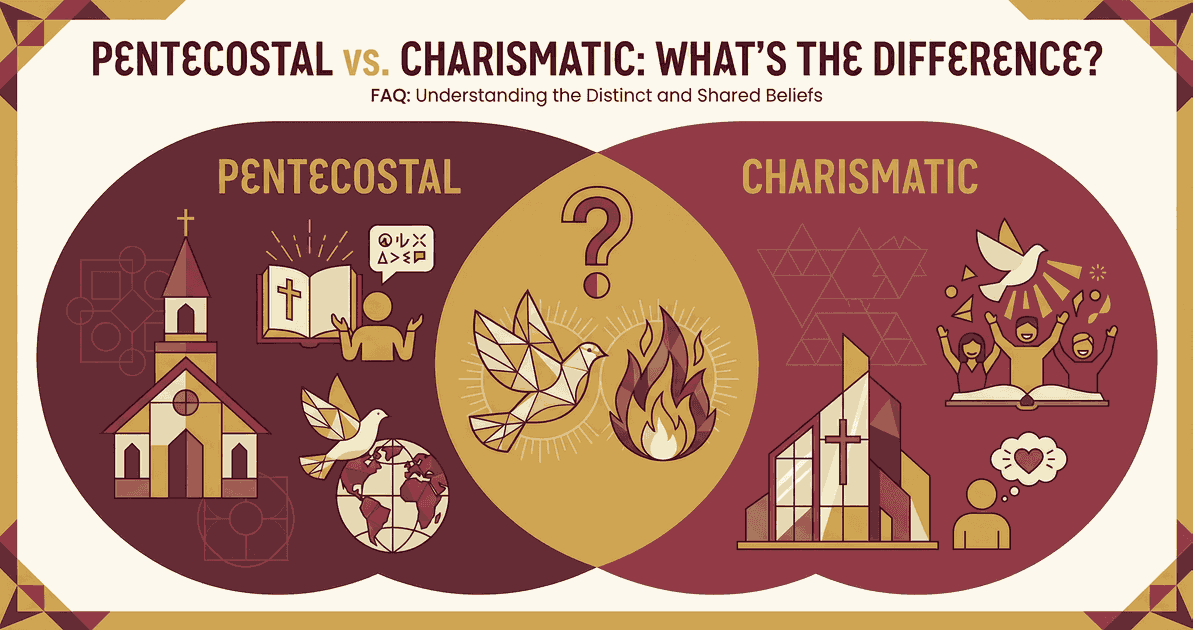
People often use "Pentecostal" and "Charismatic" interchangeably, but these terms refer to distinct movements. Understanding the differences can help you navigate the Spirit-filled landscape.
Historical Timeline
The Pentecostal Movement (1901-1960s)
The modern Pentecostal movement traces its origins to:
- 1901 — Charles Parham's Bible school in Topeka, Kansas, where Agnes Ozman spoke in tongues
- 1906 — The Azusa Street Revival in Los Angeles, which spread Pentecostalism worldwide
Pentecostals formed their own denominations, including:
- Assemblies of God (1914)
- Church of God in Christ (1907)
- Church of God (Cleveland, TN)
- Foursquare Church (1927)
- Pentecostal Church of God
The Charismatic Movement (1960s-present)
The Charismatic movement began when mainline denomination members started experiencing Spirit baptism while remaining in their churches:
- 1960 — Dennis Bennett, an Episcopal priest, received the baptism in the Holy Spirit
- The movement spread to Catholic, Lutheran, Presbyterian, Methodist, and other denominations
Key Differences
Denominational Structure
Pentecostal: Generally formed separate denominations with distinct organizational structures
Charismatic: Typically remain within mainline denominations or form non-denominational churches
Doctrine of Evidence
Pentecostal: Classically teach that speaking in tongues is the initial evidence of Spirit baptism
Charismatic: Often more flexible, seeing tongues as one possible evidence among many
Worship Style
Pentecostal: Often more structured (though expressive) with established patterns
Charismatic: May blend more traditional elements from their background denominations with Spirit-filled worship
Theological Background
Pentecostal: Emerged from Holiness and evangelical backgrounds
Charismatic: Come from diverse theological traditions (Catholic, mainline Protestant, evangelical)
Common Ground
Despite differences, both movements share:
- Belief in the baptism of the Holy Spirit as an experience subsequent to (or distinct aspect of) conversion
- Expectation of spiritual gifts for today (tongues, prophecy, healing, etc.)
- Emphasis on the Holy Spirit's active work in the church
- Experiential worship that makes room for the Spirit
- Belief in divine healing and the supernatural
The Third Wave
Worth mentioning is the "Third Wave" or Neo-Charismatic movement (1980s-present), characterized by:
- Signs and wonders emphasis
- Less focus on tongues as initial evidence
- Often independent or networked churches
- Leaders like John Wimber (Vineyard), C. Peter Wagner
A Global Movement
Together, Pentecostals and Charismatics represent the fastest-growing segment of Christianity—over 600 million believers worldwide. Despite their differences, they form a family united by:
- Love for Jesus
- Hunger for the Spirit
- Expectation of the supernatural
- Passion for evangelism
Which Am I?
If you're Spirit-filled and wondering which category you fit:
You might be more Pentecostal if you:
- Belong to a classical Pentecostal denomination
- Believe tongues is the initial evidence of Spirit baptism
- Have roots in Holiness or evangelical traditions
You might be more Charismatic if you:
- Are Spirit-filled within a mainline denomination
- Are open to various evidences of Spirit baptism
- Come from Catholic, liturgical, or mainline backgrounds
You might be Third Wave if you:
- Focus on "power evangelism" and signs and wonders
- Are in an independent or networked church
- Don't emphasize tongues as initial evidence
What Really Matters
Labels are less important than reality. The question isn't "Am I Pentecostal or Charismatic?" but:
- Am I filled with the Spirit?
- Am I walking in spiritual power?
- Am I using my gifts for God's glory?
- Am I part of a community where the Spirit moves freely?
That's what truly counts.
Have questions about different Christian traditions? Ask PentecostalGPT for informed, balanced answers.
Have questions about this topic?
Ask PentecostalGPT for personalized, Scripture-based guidance.